Queering the MNAR European Art Gallery: Difference between revisions
No edit summary |
|||
| Line 34: | Line 34: | ||
<br> | <br> | ||
<gallery> | <gallery> | ||
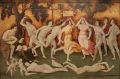
Alegoria1-GiovanniBattistaCavalletto.jpg|Allegory 1 by Giovanni Battista Cavalletto, (c) Lumi Rațiu, | Alegoria1-GiovanniBattistaCavalletto.jpg|Allegory 1 by Giovanni Battista Cavalletto, (c) Lumi Rațiu, 2026_____ | ||
#nonnormative, #genderroles, #notsanitisedbodies_____ | |||
The work might be inspired by the ”What I believe” / Paul Cadmus, 1947/48, tempera on panel, a painting sharply divided in two halves: the homosexuals poets, artists, musicians and creative labourers on the one side, and the decay, war, death and overweight representation of heterosexuals families with children on the right side; The overall suggestion is that the world needs compassion and arts, to survive._____ | |||
The Cavalleto's Allegory 1 represents pairs of young females and pairs of young men dancing with joy on the upper side of the artwork, while the lower side presents a laid down couple with a child that could be dead or drunken while other two children mid play seems also very worried about them. | |||
</gallery> | </gallery> | ||
Revision as of 21:57, 4 July 2026
Introduction
Traditional art museums in Romania, including national museums of contemporary art, actively avoid a critical discussion of methodological aspects of a queer perspective in interpreting, exhibiting, and organizing museum collections, preserving museum’s conservatory approaches in supporting “heteronormative” narratives that consolidate heterosexuality as a norm within social and cultural life. There is a need to investigate what non-normative or queer relations exist around art museum displays and collections, rethinking them through and with (de)colonial and other historical entanglements while not simply dwelling in the past but instead making connections to our present and futures. There are no queering strategy to make their collection more representative of queer people, or better represent gender and identity-related diversity. Attention should be give: queer should not be understood merely as a credible practice for museums that are officially labeled “gay” such as the Schwules Museum* in Berlin. This would be just the old practice of demarcation and segregation.
We ask ourselves:
- Is queer curating something missing from the general curating practice, not just about sexuality, but more broadly a social aesthetics through which we might rethink society?
- Are queer artists equally and/or correctly represented in museum collections?
- Are the museums descriptive texts and brochures related to the works in their collections sensitive enough to queer and identity issues?
Funding transparency:
This research has been made possible through an Individual Mobility 2025-2026 funded by the Creative Europe programme of the European Union and implemented by Goethe-Institut. This publication was produced with the financial assistance of the European Union. The views expressed herein can in no way be taken to reflect the official opinion of the European Union.
Queering the museum
The National Museum of Art of Romania hosts Romania’s premier collection of European art: the European Art Gallery. Paintings by Domenico Veneziano, Jacopo Bassano, Bronzino, Tintoretto and Luca Giordano tell a story of Italian art throughout nearly four centuries, while those of Rembrandt and Jan Davidsz de Heem remind visitors of the Golden Age of Dutch art. Flemish art of the 17th century is particularly well represented through works by Pieter Paul Rubens, Pieter van Mol, Pieter Brueghel the Younger and Jan Brueghel the Elder. Spanish school highlights focus on three El Greco paintings illustrative of his career development. The German school includes works by Lucas Cranach the Elder and Hans von Aachen, whereas the French one brings center stage paintings by famous 19th century artists such as Claude Monet, Paul Signac and Alfred Sisley alongside sculptures by Auguste Rodin, Camille Claudel and Antoine Bourdelle.
Findings of interest:
- Some of the works are digitalised by the museum and can be visualised online, at high resolution here: [1]
- The labels are trilingual and comprise the details on technique
- The works are in a good conservation state
- From time to time there are works taken out from storage and shown to visitors, alongside specialised talks about them
- There are chairs and sofas to accommodate visitors, in almost every room, however the antique sofas, still in use for visitors, are in poor condition, requiring restoration
Ensaddening findings:
- There are only two paintings created by women painters, represented in the Gallery.
- The elevators ensuring the access to people with disabilities does not work.
- There is no room provided for mother-with-child.
- There are no references to queer issues-aspects, neither in the museum or the museum bookshop.
- Some of the room attendants were on loudly phone-speaking with their relatives, talking mundane subjects like rent, prices and quality of life.
Recommended Queer Guide of the MNAR European Art Gallery, Bucharest
Allegory 1 by Giovanni Battista Cavalletto, (c) Lumi Rațiu, 2026_____

