Queering the Văcărești Monastery Frescoes: Difference between revisions
| (4 intermediate revisions by the same user not shown) | |||
| Line 17: | Line 17: | ||
== Funding transparency: == | == Funding transparency: == | ||
<br>This research has been made possible through an Individual Mobility 2025-2026 funded by the Creative Europe programme of the European Union and implemented by Goethe- | <br>This research has been initiated and made possible through an Individual Mobility 2025-2026 funded by the Creative Europe programme of the European Union and implemented by Goethe-Institute. The initial research was produced with the financial assistance of the European Union. The views expressed herein can in no way be taken to reflect the official opinion of the European Union. Further development of research, such as this particular page, occurred on independent funding sources, mainly own funding. | ||
<br> | <br> | ||
<br> | <br> | ||
| Line 23: | Line 23: | ||
== Queering the museum == | == Queering the museum == | ||
<br> | <br> | ||
Documentation & Research carried out by Lumi Rațiu and [[Alex Bodea]], Bucharest, | Documentation & Research carried out by Lumi Rațiu and [[Alex Bodea]], Bucharest, Filipescu-Cesianu House, Bucharest Museum, July 2026. | ||
<br> | <br> | ||
The Văcărești Monastery ensemble had a turbulent past, affected by fires and earthquakes, transformed into a penitentiary for revolutionary prisoners in 1848 and during the peasant uprisings of 1864. Since 2017, the Bucharest Municipality Museum has brought to the public's attention, at the Filipescu-Cesianu House, frescoes as part of the exhibition "In the vicinity of the saints. Frescoes of the Văcărești Monastery". | The Văcărești Monastery ensemble had a turbulent past, affected by fires and earthquakes, transformed into a penitentiary for revolutionary prisoners in 1848 and during the peasant uprisings of 1864. Since 2017, the Bucharest Municipality Museum has brought to the public's attention, at the Filipescu-Cesianu House, frescoes as part of the exhibition "In the vicinity of the saints. Frescoes of the Văcărești Monastery". | ||
| Line 45: | Line 45: | ||
Saintandronicus.jpg|'''Saint Andronicus / Sfântul Andronic''' fresco fragment, photo by (c) Lumi Rațiu, 2026; '''Queered role:''' queer devotion, spiritual queer brotherhood; '''Queered guidance:''' Because Andronicus, Tarachus, and Probus travelled, suffered, and were buried together, historical figures who died in groups are occasionally looked at through a modern queer lens by some contemporary commentators. Generally speaking, at that time, because Christians called each other "brothers and sisters" and gave each other the "kiss of peace," there were rumours that their secret gatherings involved so-called "orgies". | Saintandronicus.jpg|'''Saint Andronicus / Sfântul Andronic''' fresco fragment, photo by (c) Lumi Rațiu, 2026; '''Queered role:''' queer devotion, spiritual queer brotherhood; '''Queered guidance:''' Because Andronicus, Tarachus, and Probus travelled, suffered, and were buried together, historical figures who died in groups are occasionally looked at through a modern queer lens by some contemporary commentators. Generally speaking, at that time, because Christians called each other "brothers and sisters" and gave each other the "kiss of peace," there were rumours that their secret gatherings involved so-called "orgies". | ||
Monasterybros.jpg|'''Monastery brotherhood''' fresco fragment, photo by (c) Lumi Rațiu, 2026; '''Queered role:''' queer devotion, spiritual queer brotherhood, performing male vulnerability; '''Queered guidance:''' Generally speaking, at that time, because Christians called each other "brothers and sisters" and gave each other the "kiss of peace," there were rumours that their secret gatherings involved so-called "orgies". The Christian brotherhood often mirrored modern queer chosen families: an environment where men performed tasks traditionally coded as "feminine" (e.g., cooking, sewing, nursing, weaving), which disrupted traditional gender binaries of the time, and, contrary to the modern "bro culture" that prizes emotional stoicism, the monastic "gift of tears" (weeping during prayer) and public confessions celebrated a rather radical, soft, and expressive form of masculinity. | Monasterybros.jpg|'''Monastery brotherhood''' fresco fragment, photo by (c) Lumi Rațiu, 2026; '''Queered role:''' queer devotion, spiritual queer brotherhood, performing male vulnerability; '''Queered guidance:''' Generally speaking, at that time, because Christians called each other "brothers and sisters" and gave each other the "kiss of peace," there were rumours that their secret gatherings involved so-called "orgies". The Christian brotherhood often mirrored modern queer chosen families: an environment where men performed tasks traditionally coded as "feminine" (e.g., cooking, sewing, nursing, weaving), which disrupted traditional gender binaries of the time, and, contrary to the modern "bro culture" that prizes emotional stoicism, the monastic "gift of tears" (weeping during prayer) and public confessions celebrated a rather radical, soft, and expressive form of masculinity. | ||
Arhangelulmihail.jpg|'''Michael Archangel''' fresco fragment, photo by (c) Lumi Rațiu, 2026; '''Queered role:''' men in skirt, gender fluidity, non-conforming bodies, non-normative kinship; '''Queered guidance:''' Archangel Michael is a prominent spiritual figure in Judaism, Christianity, and Islam, known as a leader of the heavenly hosts and a warrior against evil. In Matthew 22:30, Jesus says of angels that they “neither marry nor are given in marriage.” This is not necessarily a statement that angels are “non-binary,” but it does place them outside the usual human structure of marriage and reproduction. Angels re frequently depicted with androgynous bodies; faces can have both masculine and feminine features; long hair and flowing clothing blur gender markers. They are definitely beings who do not conform to the human system of marriage, reproduction, and gender. | |||
</gallery> | </gallery> | ||
<br> | <br> | ||
Latest revision as of 19:57, 11 August 2026
Introduction
Traditionally, art museums in Romania, with a little but perhaps insufficient exception at the national museum of contemporary art, actively avoid a critical discussion of methodological aspects of a queer perspective in interpreting, exhibiting, and organizing museum collections, preserving museum’s conservatory approaches in supporting “heteronormative” narratives that consolidate heterosexuality as a norm within social and cultural life. There is a need to investigate what non-normative or queer relations exist around art museum displays and collections, rethinking them through and with (de)colonial and other historical entanglements while not simply dwelling in the past but instead making connections to our present and futures. There are no queering strategy to make their collection more representative of queer people, or better represent gender and identity-related diversity. Attention should be give: queer should not be understood merely as a credible practice for museums that are officially labelled “gay” such as the Schwules Museum* in Berlin. This would be just the old practice of demarcation and segregation.
Particularly the church needs a fresh and relevant queering approach of the church and monastery life, a long-running debate for the church, but relevant well beyond the conversation around sexuality. It asks deep questions about gender, power, and who belongs, and the gay and lesbians living hidden or openly within church structures, disrupting traditional, heteronormative institutional narratives to uncover hidden histories, marginalized voices, and alternative spiritualities.
We particularly ask ourselves questions such as:
- Why does the institutional church focus so much on sexual rules instead of core gospel missions?
- Does the Bible's creation of "male and female" mean that God holds both genders or goes beyond gender, and thus there is a fluid array around these extreme points of reference?
- What do we know about the domestic arrangements, romantic partnerships, and gender presentations of the saints portrayed in church related paintings?
- How does the imagery subvert the binary? In what ways do representations of angels, saints, and divine figures trouble or transcend traditional boundaries of male and female, human and divine, spiritual and physical?
- Which non-normative relationships are canonized? How can we read the intense, intimate pairings in church history—such as Saints Sergius and Bacchus, Saints Perpetua and Felicitas, or David and Jonathan—through a lens of queer kinship and chosen family?
- How has archival naming flattened identity? Do institutional cataloging terms, subject headings, and labels rely on heteronormative assumptions (e.g., labeling an intimate same-sex pair as merely "friends" or "companions")?
Funding transparency:
This research has been initiated and made possible through an Individual Mobility 2025-2026 funded by the Creative Europe programme of the European Union and implemented by Goethe-Institute. The initial research was produced with the financial assistance of the European Union. The views expressed herein can in no way be taken to reflect the official opinion of the European Union. Further development of research, such as this particular page, occurred on independent funding sources, mainly own funding.
Queering the museum
Documentation & Research carried out by Lumi Rațiu and Alex Bodea, Bucharest, Filipescu-Cesianu House, Bucharest Museum, July 2026.
The Văcărești Monastery ensemble had a turbulent past, affected by fires and earthquakes, transformed into a penitentiary for revolutionary prisoners in 1848 and during the peasant uprisings of 1864. Since 2017, the Bucharest Municipality Museum has brought to the public's attention, at the Filipescu-Cesianu House, frescoes as part of the exhibition "In the vicinity of the saints. Frescoes of the Văcărești Monastery".
Positive aspects of the visit:
- The labels are bilingual
- The works are in a good conservation and restauration state
- There is a free of charge, welcoming garden to accommodate visitors
Ensaddening findings:
- The room is provided with air-conditioning that serves mainly the needs of the staff members; questionable if their temperature is set according to conservation needs; in fact, despite the air-conditioning, the doors are kept wide open and tree leaves circulates constantly in and out of the exhibition hall.
- There is no room or facility provided for parent-with-child. The toilet is unique and small.
- There are no references to queer issues-aspects, neither in the museum or the museum bookshop.
- The framing is made of brute steel profiles, which seems taken directly from a blacksmith shop; some frames are in a deplorable state (with broken and hanging parts).
Recommended Queer Guide of the Văcărești Monsastery Collection of Frescoes, Bucharest Museum
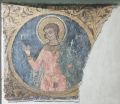
Saint Mocius / Sfântul Mochie fresco fragment, photo by (c) Lumi Rațiu, 2026; Queered role: chosen celibacy; Queered guidance: Saint Mocius (also known as Mochios of Amphipolis) was a 3rd-century Christian priest and martyr from Amphipolis in Macedonia. Born to wealthy and noble parents, Euphratius and Eustathia, he chose a spiritual path over material wealth and became a priest. Unusual and not mandatory for his time, he has deliberately chosen celibacy. In Roman society of sec. III, marriage was an important social institution, and families, especially wealthy ones like that of Mocius, had strong and concrete interests in a man's marriage: offspring, alliances, property, and family continuity. We can relate our questions on his chosen celibacy, unusual for that time, to the fact that Christian asceticism usually offers clerics a real social alternative to marriage. Mandatory celibacy in monachal structures was becoming a norm starting only with sec. VII.
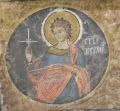
Saint Dorimendont / Sfântul Dorumen (Dorumendont) fresco fragment, photo by (c) Lumi Rațiu, 2026; Queered role: romantic loyalty, queer devotion, sudden loyalty; Queered guidance: Saint Dorimedont, a 3rd-century Christian martyr, was a loyal friend to the martyr Saint Trophimus. Dorimedont was a local senator who, out of the blue, visited Trophimus in secret, when the latter was put in prison, to care for his wounds. When caught, he assumed the Christian faith, too, along his friend Trophimus, and both were subsequently executed. Saint Trophimus had been cruelly tortured in Antioch and then sent as a prisoner to the city of Sinada in Phrygia. There he was thrown into prison, with serious wounds all over his body. Dorimedont, who was a respected senator and member of the city council, suddenly risked everything and went to prison to wash Trophimus' wounds, bring him food, and alleviate his suffering. Caught in the act of care, Dorimedont suddenly claimed Christian faith and remained beside his friend in torture. The two of them have been tortured together, both put naked with wild animals in the public amphitheatre, were murdered together and were buried together. Escaping from amphitheatre, the executioner gave the final order that both saints be beheaded with the same sword, at the same time.
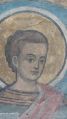
Saint Andronicus / Sfântul Andronic fresco fragment, photo by (c) Lumi Rațiu, 2026; Queered role: queer devotion, spiritual queer brotherhood; Queered guidance: Because Andronicus, Tarachus, and Probus travelled, suffered, and were buried together, historical figures who died in groups are occasionally looked at through a modern queer lens by some contemporary commentators. Generally speaking, at that time, because Christians called each other "brothers and sisters" and gave each other the "kiss of peace," there were rumours that their secret gatherings involved so-called "orgies".
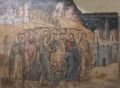
Monastery brotherhood fresco fragment, photo by (c) Lumi Rațiu, 2026; Queered role: queer devotion, spiritual queer brotherhood, performing male vulnerability; Queered guidance: Generally speaking, at that time, because Christians called each other "brothers and sisters" and gave each other the "kiss of peace," there were rumours that their secret gatherings involved so-called "orgies". The Christian brotherhood often mirrored modern queer chosen families: an environment where men performed tasks traditionally coded as "feminine" (e.g., cooking, sewing, nursing, weaving), which disrupted traditional gender binaries of the time, and, contrary to the modern "bro culture" that prizes emotional stoicism, the monastic "gift of tears" (weeping during prayer) and public confessions celebrated a rather radical, soft, and expressive form of masculinity.
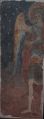
Michael Archangel fresco fragment, photo by (c) Lumi Rațiu, 2026; Queered role: men in skirt, gender fluidity, non-conforming bodies, non-normative kinship; Queered guidance: Archangel Michael is a prominent spiritual figure in Judaism, Christianity, and Islam, known as a leader of the heavenly hosts and a warrior against evil. In Matthew 22:30, Jesus says of angels that they “neither marry nor are given in marriage.” This is not necessarily a statement that angels are “non-binary,” but it does place them outside the usual human structure of marriage and reproduction. Angels re frequently depicted with androgynous bodies; faces can have both masculine and feminine features; long hair and flowing clothing blur gender markers. They are definitely beings who do not conform to the human system of marriage, reproduction, and gender.


Copyrights and Reproduction of research findings and materials
The views expressed herein and all related audio-video-photo materials are under copyright licence, restricted to non-commercial use only and requiring full attribution to prevent infringement. Failing to credit the creators can lead to plagiarism accusations, and missing required credits on licensed materials breaches copyright terms.
_____________________________________________________________________
