Queering the Zambaccian Collection: Difference between revisions
| (3 intermediate revisions by the same user not shown) | |||
| Line 37: | Line 37: | ||
<br> | <br> | ||
<gallery> | <gallery> | ||
NudeMilitaPetrascu.jpg|'''Nude''' by ''Milița Petrașcu'', bronze; (c) Lumi Rațiu, 2026; '''Queered role:''' nonnormative emobodiment, androgynous aesthetics, queer Romanian female artist; '''Queered guidance:''' The work is one of several nudes by Petrașcu in the Zambaccian collection and has been exhibited as part of the museum's Romanian modern art holdings. The work challenges conventional representations of the human body through its stylized anatomy and reduced emphasis on sexually differentiated features. Rather than reinforcing fixed ideals of femininity or masculinity, the sculpture foregrounds the body's sculptural form, producing an ambiguous corporeality that resists binary classification. There is some scholarly discussion and biographical speculation about Milița Petrașcu having romantic relationships with women: she never married and she maintained close, lifelong relationships with several women in artistic and intellectual circles. | |||
NudeonaDecorativeBackground-Tonitza.jpg|'''Nude on a Decorative Background''', by ''Nicolae Tonitza'', photo by (c) Lumi Rațiu, 2026; '''Queered role:''' questionable depiction of children nudity, institutional silence; '''Queered guidance:''' Historically, many artists—including Michelangelo, Pierre-Auguste Renoir, Mary Cassatt, and Nicolae Tonitza, depicted unclothed children within artistic traditions that associated childhood with innocence, family life, allegory, or the study of the human form. A different question is whether Tonitza's work sexualizes children or invites a problematic gaze, since Nicolae Tonitza painted a number of nude or partially nude children and adolescents as main opera. This work depicts a young girl wearing only a striped chemise and is catalogued as part of Romania's national cultural heritage. Original title does not include reference to the age, but the institution where the work is shown includes the word Woman in the English translation of the work museum label. It is debatable, as a choice that seems to be meant precisely to silence any potential criticism against Tonitza underaged nude subjects, as discussions of childhood, vulnerability, and the history of the nude. | |||
</gallery> | </gallery> | ||
<br> | <br> | ||
Latest revision as of 19:36, 26 July 2026
Introduction
Traditionally, art museums in Romania, with a little but perhaps insufficient exception at the national museum of contemporary art, actively avoid a critical discussion of methodological aspects of a queer perspective in interpreting, exhibiting, and organizing museum collections, preserving museum’s conservatory approaches in supporting “heteronormative” narratives that consolidate heterosexuality as a norm within social and cultural life. There is a need to investigate what non-normative or queer relations exist around art museum displays and collections, rethinking them through and with (de)colonial and other historical entanglements while not simply dwelling in the past but instead making connections to our present and futures. There are no queering strategy to make their collection more representative of queer people, or better represent gender and identity-related diversity. Attention should be give: queer should not be understood merely as a credible practice for museums that are officially labeled “gay” such as the Schwules Museum* in Berlin. This would be just the old practice of demarcation and segregation.
We ask ourselves:
- Is queer curating something missing from the general curating practice, not just about sexuality, but more broadly a social aesthetics through which we might rethink society?
- Are queer artists equally and/or correctly represented in museum collections?
- Are the museums descriptive texts and brochures related to the works in their collections sensitive enough to queer and identity issues?
Funding transparency:
This research has been made possible through an Individual Mobility 2025-2026 funded by the Creative Europe programme of the European Union and implemented by Goethe-Institute. This publication was produced with the financial assistance of the European Union. The views expressed herein can in no way be taken to reflect the official opinion of the European Union.
Queering the museum
Documentation & Research carried out by Lumi Rațiu and Alex Bodea, Bucharest, MNAR European Art Gallery, July 2026.
Collector and art critic Krikor H. Zambaccian (1889-1962) assembled a valuable art collections in Romania and built, in 1940s, a house specifically to showcase the paintings, sculptures, graphics, and furniture he had acquired over half a century. Both the collection and the house were donated to the Romanian state in 1947, and Zambaccian was welcomed as a member of the Romanian Academy. The Romanian artists represented are Theodor Aman, Nicolae Grigorescu, Ioan Andreescu, Ștefan Luchian, Nicolae Tonitza, Theodor Pallady, Gheorghe Petrașcu, Corneliu Baba, Alexandru Phoebus, and Horia Damian, with sculptures by Brâncuși, Milița Petrașcu, Oscar Han, and Cornel Medrea. From abroad, the collection acquired a series of paintings by renowned masters such as Cézanne, Picasso, Matisse, Bonnard, Utrillo, Marquet.
Positive aspects of the visit:
- Some of the works are digitalised by the museum and can be visualised online, at high resolution here: [1]
- The labels are trilingual and comprise the details on technique
- The works are in a good conservation state (however, there are different temperatures in the rooms which may affect the conservation)
- One of the staff members, the clothing guardian, was particularly kind with visitors.
- There are small sofas to accommodate visitors, in almost every room
- Lighting seemed appropriate for the works, and their arrangement on the walls in the house was pleasant to the onlooker.
- There are quite a few paintings created by women painters, well represented in the Collection.
Ensaddening findings:
- The house has no means to ensure access to people with disabilities and the authorities do not allow such adaptation measures to be implemented (according to one of the collection keeper present at the time of our visit).
- There is no room or facility provided for parent-with-child, despite a very large and accommodating sanitary room, with plenty of space for a diaper-change situation.
- There are no references to queer issues-aspects, neither in the museum or the museum bookshop.
- Some of the room attendants were on loudly phone-speaking with their relatives, talking about personal or family issues.
Recommended Queer Guide of the Zambaccian Collection, Bucharest
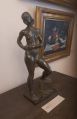
Nude by Milița Petrașcu, bronze; (c) Lumi Rațiu, 2026; Queered role: nonnormative emobodiment, androgynous aesthetics, queer Romanian female artist; Queered guidance: The work is one of several nudes by Petrașcu in the Zambaccian collection and has been exhibited as part of the museum's Romanian modern art holdings. The work challenges conventional representations of the human body through its stylized anatomy and reduced emphasis on sexually differentiated features. Rather than reinforcing fixed ideals of femininity or masculinity, the sculpture foregrounds the body's sculptural form, producing an ambiguous corporeality that resists binary classification. There is some scholarly discussion and biographical speculation about Milița Petrașcu having romantic relationships with women: she never married and she maintained close, lifelong relationships with several women in artistic and intellectual circles.
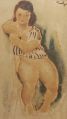
Nude on a Decorative Background, by Nicolae Tonitza, photo by (c) Lumi Rațiu, 2026; Queered role: questionable depiction of children nudity, institutional silence; Queered guidance: Historically, many artists—including Michelangelo, Pierre-Auguste Renoir, Mary Cassatt, and Nicolae Tonitza, depicted unclothed children within artistic traditions that associated childhood with innocence, family life, allegory, or the study of the human form. A different question is whether Tonitza's work sexualizes children or invites a problematic gaze, since Nicolae Tonitza painted a number of nude or partially nude children and adolescents as main opera. This work depicts a young girl wearing only a striped chemise and is catalogued as part of Romania's national cultural heritage. Original title does not include reference to the age, but the institution where the work is shown includes the word Woman in the English translation of the work museum label. It is debatable, as a choice that seems to be meant precisely to silence any potential criticism against Tonitza underaged nude subjects, as discussions of childhood, vulnerability, and the history of the nude.


Copyrights and Reproduction of research findings and materials
The views expressed herein and all related audio-video-photo materials are under copyright licence, restricted to non-commercial use only and requiring full attribution to prevent infringement. Failing to credit the creators can lead to plagiarism accusations, and missing required credits on licensed materials breaches copyright terms.
_____________________________________________________________________
