Queering the MNAR European Art Gallery: Difference between revisions
| Line 49: | Line 49: | ||
TheOriginofPainting-MatiasdeArteagaYAlfaro.jpg|'''The Origin of Painting''' by Matias de Arteaga Y Alfaro, oil on canvas, photo (c) Lumi Rațiu, 2026; '''Queered role:''' queer intimacy, mirroring, homosociality, male intimacy, subverted artistic canon; gendered iconography, gender non-conformity, queer gaze; '''Queered guidance:''' According to the ancient myth, Dibutades, the daughter of the potter Butades of Sicyon, wishing to preserve the likeness of her departing lover, traced the outline of his shadow on a wall by lamplight. Butades subsequently modelled the outline in clay and fired it, giving rise to the legendary origin of drawing and painting. Traditionally, the leitmotif of Origin of Painting is a woman who immortalise the profile shadow of her lover before he is going to join a battle; this is known as The Origin of Painting, The Maid of Corinth or The Corinthian Maid. Here, however, we see two men, the young one painting the portrait of a mature, bearded man. By replacing the conventional female–male pair with two male figures, the composition queers the canonical narrative of the Origin of Painting, inviting alternative readings of intimacy, artistic gesture, and desire. | TheOriginofPainting-MatiasdeArteagaYAlfaro.jpg|'''The Origin of Painting''' by Matias de Arteaga Y Alfaro, oil on canvas, photo (c) Lumi Rațiu, 2026; '''Queered role:''' queer intimacy, mirroring, homosociality, male intimacy, subverted artistic canon; gendered iconography, gender non-conformity, queer gaze; '''Queered guidance:''' According to the ancient myth, Dibutades, the daughter of the potter Butades of Sicyon, wishing to preserve the likeness of her departing lover, traced the outline of his shadow on a wall by lamplight. Butades subsequently modelled the outline in clay and fired it, giving rise to the legendary origin of drawing and painting. Traditionally, the leitmotif of Origin of Painting is a woman who immortalise the profile shadow of her lover before he is going to join a battle; this is known as The Origin of Painting, The Maid of Corinth or The Corinthian Maid. Here, however, we see two men, the young one painting the portrait of a mature, bearded man. By replacing the conventional female–male pair with two male figures, the composition queers the canonical narrative of the Origin of Painting, inviting alternative readings of intimacy, artistic gesture, and desire. | ||
TheVisitation-LitterioPaladini.jpg|'''The Visitation''' by Litterio Palatini, oil on canvas, photo by (c) Lumi Rațiu, 2026; '''Queered role:''' female intimacy, affective solidarity, female solidarity, women's community, women trust, feminine alliance, non-normative kinship; '''Queered guidance:''' The Visitation depicts the meeting between the Virgin Mary and Elizabeth (Luke 1:39–56), a scene long associated with mutual recognition, care, and embodied connection. The close physical and emotional bond between Mary and Elizabeth lends itself to queer interpretations. The Visitation foregrounds the intimate encounter between Mary and Elizabeth, inviting a queer reading centred on female solidarity, embodied care, and alternative forms of kinship that extend beyond the patriarchal family. | TheVisitation-LitterioPaladini.jpg|'''The Visitation''' by Litterio Palatini, oil on canvas, photo by (c) Lumi Rațiu, 2026; '''Queered role:''' female intimacy, affective solidarity, female solidarity, women's community, women trust, feminine alliance, non-normative kinship; '''Queered guidance:''' The Visitation depicts the meeting between the Virgin Mary and Elizabeth (Luke 1:39–56), a scene long associated with mutual recognition, care, and embodied connection. The close physical and emotional bond between Mary and Elizabeth lends itself to queer interpretations. The Visitation foregrounds the intimate encounter between Mary and Elizabeth, inviting a queer reading centred on female solidarity, embodied care, and alternative forms of kinship that extend beyond the patriarchal family. | ||
VenusandCupid-GiorgioVasari.jpg|'''Venus and Cupid''', by Giogio Vasari, oil on wood, photo by (c) Lumi Rațiu, 2026; '''Queered role:''' non-normative bodies, ambiguous corporeality, aesthetics of indeterminacy; '''Queered guidance:''' Venus and Cupid presents bodies whose forms and gestures resist fixed gender classifications, an ambiguous corporeality that unsettles binary distinctions between masculine and feminine. In Renaissance including the work of Giorgio Vasari, female bodies were often constructed using male anatomical models, as access to female nude models was limited or prohibited in many workshops and academies. This often created a non-intentionally effect: the ambiguous corporeality. Read through a queer lens, the painting invites reflection on non-normative embodiment and the instability of fixed gender categories. | |||
</gallery> | </gallery> | ||
<br> | <br> | ||
Latest revision as of 18:45, 26 July 2026
Introduction
Traditionally, art museums in Romania, with a little but perhaps insufficient exception at the national museum of contemporary art, actively avoid a critical discussion of methodological aspects of a queer perspective in interpreting, exhibiting, and organizing museum collections, preserving museum’s conservatory approaches in supporting “heteronormative” narratives that consolidate heterosexuality as a norm within social and cultural life. There is a need to investigate what non-normative or queer relations exist around art museum displays and collections, rethinking them through and with (de)colonial and other historical entanglements while not simply dwelling in the past but instead making connections to our present and futures. There are no queering strategy to make their collection more representative of queer people, or better represent gender and identity-related diversity. Attention should be give: queer should not be understood merely as a credible practice for museums that are officially labeled “gay” such as the Schwules Museum* in Berlin. This would be just the old practice of demarcation and segregation.
We ask ourselves:
- Is queer curating something missing from the general curating practice, not just about sexuality, but more broadly a social aesthetics through which we might rethink society?
- Are queer artists equally and/or correctly represented in museum collections?
- Are the museums descriptive texts and brochures related to the works in their collections sensitive enough to queer and identity issues?
Funding transparency:
This research has been made possible through an Individual Mobility 2025-2026 funded by the Creative Europe programme of the European Union and implemented by Goethe-Institut. This webpage was produced with the financial assistance of the European Union. The views expressed herein can in no way be taken to reflect the official opinion of the European Union.
Queering the museum
Documentation & Research carried out by Lumi Rațiu and Alex Bodea, Bucharest, MNAR European Art Gallery, July 2026.
The National Museum of Art of Romania hosts Romania’s premier collection of European art: the European Art Gallery. Paintings by Domenico Veneziano, Jacopo Bassano, Bronzino, Tintoretto and Luca Giordano tell a story of Italian art throughout nearly four centuries, while those of Rembrandt and Jan Davidsz de Heem remind visitors of the Golden Age of Dutch art. Flemish art of the 17th century is particularly well represented through works by Pieter Paul Rubens, Pieter van Mol, Pieter Brueghel the Younger and Jan Brueghel the Elder. Spanish school highlights focus on three El Greco paintings illustrative of his career development. The German school includes works by Lucas Cranach the Elder and Hans von Aachen, whereas the French one brings center stage paintings by famous 19th century artists such as Claude Monet, Paul Signac and Alfred Sisley alongside sculptures by Auguste Rodin, Camille Claudel and Antoine Bourdelle.
Positive aspects of the visit:
- Some of the works are digitalised by the museum and can be visualised online, at high resolution here: [1]
- The labels are trilingual and comprise the details on technique
- The works are in a good conservation state
- From time to time there are works taken out from storage and shown to visitors, alongside specialised talks about them
- There are chairs and sofas to accommodate visitors, in almost every room, however the antique sofas, still in use for visitors, are in poor condition, requiring restoration
Ensaddening findings:
- There are only two paintings created by women painters, represented in the Gallery.
- The elevators ensuring the access to people with disabilities does not work.
- There is no room or facility provided for parent-with-child.
- There are no references to queer issues-aspects, neither in the museum or the museum bookshop.
- Some of the room attendants were on loudly phone-speaking with their relatives, talking about personal or family issues.
Recommended Queer Guide of the MNAR European Art Gallery, Bucharest
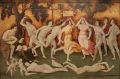
Allegory 1 by Giovanni Battista Cavalletto, tempera on wood, provenience King Carol I Art Collection, currently in the National Romanian Museum of Art Collection; (c) Lumi Rațiu, 2026; Queered role: nonnormative, genderroles, notsanitisedbodies; Queered guidance: The work might be inspired by the ”What I believe” / Paul Cadmus, 1947/48, tempera on panel, a painting sharply divided in two halves: the homosexuals poets, artists, musicians and creative labourers on the one side, and the decay, war, death and overweight representation of heterosexuals families with children on the right side; The overall suggestion is that the world needs compassion and arts, to survive. The Cavalleto's Allegory 1 represents pairs of young females and pairs of young men dancing with joy on the upper side of the artwork, while the lower side presents a laid down couple with a child that could be dead or drunken while other two children mid play seems also very worried about them.
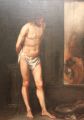
Christ at the Column by Alonso Cano, oil on canvas, provenience King Carol I Art Collection, currently in the National Romanian Museum of Art Collection; (c) Lumi Rațiu, 2026; Queered role: biographical erasure / sanitisation, reputational whitewashing, unethical decontextualization, violence omission, institutional silence; Queered guidance: The work in presented in the museum omitting gendered violence allegations, concerning violence against women. Alonso Cano (1601–1667) was a renowned Spanish Baroque painter, sculptor, and architect. He is considered one of the great all-around artists of Spain's Golden Age. His life was also turbulent. He was accused of murdering his wife. The accusation remained unproven and he was not convicted. Cano's wife was found stabbed to death in their Madrid home. He soon fled Madrid to Valencia to avoid arrest, and was later tried and tortured to extract a confession, but was ultimately acquitted of the crime. Institutional silence is a concept used in critical museum studies, memory studies, and feminist scholarship to describe the ways institutions produce meaning not only through what they display, but also through what they choose not to disclose. Silence is therefore understood as an active curatorial practice rather than a neutral absence of information.
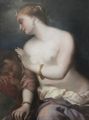
Diana and Endymion by Marco Liberi, oil on canvas, provenience State Pinacotheca, currently in the National Romanian Museum of Art Collection; photo by (c) Lumi Rațiu, 2026; Queered role: consent, non-normative desire, gender performativity; Queered guidance: The work reverse traditional women role, displayed as erotic objects, as here Endymion, the beautiful young man, becomes the object of her visual pleasure. Diana occupies the active position: she looks, desires, and approaches. This inversion destabilizes normative gendered structures of looking. Following Judith Butler, one could argue that Diana performs femininity in unstable ways.
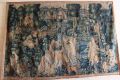
Genre Scene, tapestry, author: French Workshop, sec. XVII, wool, silk, basse-lisse, provenience Communist Party Household, currently in the National Romanian Museum of Art Collection, photo by (c) Lumi Rațiu, 2026; Queered role: safe space, queer ethics; Queered guidance: The work presents an all-inclusive women space, despite one male person which seems to be a hunter, peripheral, ignored from the women's social world. The presence of a single male hunter can highlight the autonomy of female relationships. The visual focus remain on the women safe space, represented as complete social subjects without being defined by male desire.
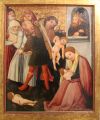
Killing of the Innocents, author: Master of the Krainburg Altar, currently in the National Romanian Museum of Art Collection, photo by (c) Lumi Rațiu, 2026; Queered role: gender-violence, institutional silence, state-condoned violence, biopolitics; Queered guidance: The work presents the biblical quoted episode of killing the babies. The museal label often describe the narrative without reference to the gender-violence, maternal trauma and the male-led criminality, often perpetuated against the weakest in a society, or the state-condoned violence, a violence that the state permits, tolerates, or fails to prevent. The massacre described in this artwork targets a category of people defined by age and sex, making the children's bodies objects of sovereign calculation, a form of biopower, a means of controlling, organizing, or otherwise governing large groups of people by placing limitations and controls on their bodies.
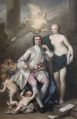
Portrait of countertenor Carlo Broschi, called Farinelli, autor: Jacopo Amigoni, oil on canvas, ', currently in the National Romanian Museum of Art Collection, photo by (c) Lumi Rațiu, 2026; Queered role: sexual mutilation, male genital mutilation, survivor, alterated biology, non-conforming, vocal androgyny, non-binary precursor; Queered guidance: The work depicts the famous 18th-century castrato singer, Carlo Broschi, who was castrated before puberty with the aim of enhancing his vocal range, spanning soprano and alto. This physically separated him from conventional male or female categories and severly impacted his social and intimate life. The 1994 film about Carlo Broschi heavily leans into this by portraying him as an almost mythological, sexually fluid being who shares intimate physical relationships with women alongside his brother, who acts as his anatomical surrogate. His figure is used by modern curators to link historical figures to contemporary non-binary identities without erasing historical context.
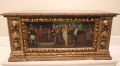
St Juliana Martyrdom - Cassone (Wood box), wood box and oil on canvas, author: Unknown, provenience: the Carol I Royal Collection, photo by (c) Lumi Rațiu, 2026; Queered role: marriage refusal, religious celibacy as female agency, forced marriage, historical forced marriage; Queered guidance: The work depicts St Juliana, a woman who invokes religious consecration to avoid a forced marriage and asserts her autonomy, even at the cost of martyrdom. Such examples in history that can be considered a religious celibacy as a form of female agency can be researched also into Saint Agnes — rejected all suitors because she considered herself "betrothed to Christ.", Saint Lucy — dedicated her virginity to God and refused marriage, Saint Catherine of Alexandria — refused an imperial marriage proposal.
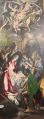
The Adoration of the Shepherds, by Doménikos Theotokópoulos, called El Greco, oil on canvas, 364 x 137 cm, photo by (c) Lumi Rațiu, 2026; Queered role: queer aesthetics, distress as queer desire, male beauty, erotic spirituality, camp aesthetics, gender non-conformity, martyrcore; Queered guidance: El Greco's paintings are often read through a queer lens for their androgynous figures, spiritual sensuality, and emotionally charged depictions of the body. El Greco's work invites queer interpretations through its gender ambiguity.

The Adulteress before the Pharisees, by Pietro della Vecchia, known as Pietro Muttoni, oil on canvas, 242,5 x 152,7 cm, photo by (c) Lumi Rațiu, 2026; Queered role: woman stressed by men, feminism, queer-feminism, victimisation, patriarchal justice, gendered double standard, female agency, misogyny, public shaming; Queered guidance: The painting exposes legal and moral systems that disproportionately punish women. The adulteress is portrayed as the target of public humiliation, gendered blame, and patriarchal violence. The woman's vulnerability stems from the intersection of gender, social status, and legal power. Female sexual transgression is punished more visibly than male transgression. The scene foregrounds the unequal policing of female sexuality and the woman's lack of agency within patriarchal structures. The woman is condemned while her male partner remains absent from judgment. The painting exposes legal and moral systems that disproportionately punish women.
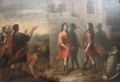
The Origin of Painting by Matias de Arteaga Y Alfaro, oil on canvas, photo (c) Lumi Rațiu, 2026; Queered role: queer intimacy, mirroring, homosociality, male intimacy, subverted artistic canon; gendered iconography, gender non-conformity, queer gaze; Queered guidance: According to the ancient myth, Dibutades, the daughter of the potter Butades of Sicyon, wishing to preserve the likeness of her departing lover, traced the outline of his shadow on a wall by lamplight. Butades subsequently modelled the outline in clay and fired it, giving rise to the legendary origin of drawing and painting. Traditionally, the leitmotif of Origin of Painting is a woman who immortalise the profile shadow of her lover before he is going to join a battle; this is known as The Origin of Painting, The Maid of Corinth or The Corinthian Maid. Here, however, we see two men, the young one painting the portrait of a mature, bearded man. By replacing the conventional female–male pair with two male figures, the composition queers the canonical narrative of the Origin of Painting, inviting alternative readings of intimacy, artistic gesture, and desire.

The Visitation by Litterio Palatini, oil on canvas, photo by (c) Lumi Rațiu, 2026; Queered role: female intimacy, affective solidarity, female solidarity, women's community, women trust, feminine alliance, non-normative kinship; Queered guidance: The Visitation depicts the meeting between the Virgin Mary and Elizabeth (Luke 1:39–56), a scene long associated with mutual recognition, care, and embodied connection. The close physical and emotional bond between Mary and Elizabeth lends itself to queer interpretations. The Visitation foregrounds the intimate encounter between Mary and Elizabeth, inviting a queer reading centred on female solidarity, embodied care, and alternative forms of kinship that extend beyond the patriarchal family.
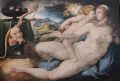
Venus and Cupid, by Giogio Vasari, oil on wood, photo by (c) Lumi Rațiu, 2026; Queered role: non-normative bodies, ambiguous corporeality, aesthetics of indeterminacy; Queered guidance: Venus and Cupid presents bodies whose forms and gestures resist fixed gender classifications, an ambiguous corporeality that unsettles binary distinctions between masculine and feminine. In Renaissance including the work of Giorgio Vasari, female bodies were often constructed using male anatomical models, as access to female nude models was limited or prohibited in many workshops and academies. This often created a non-intentionally effect: the ambiguous corporeality. Read through a queer lens, the painting invites reflection on non-normative embodiment and the instability of fixed gender categories.


Copyrights and Reproduction of research findings and materials
The views expressed herein and all related audio-video-photo materials are under copyright licence, restricted to non-commercial use only and requiring full attribution to prevent infringement. Failing to credit the creators can lead to plagiarism accusations, and missing required credits on licensed materials breaches copyright terms.
_____________________________________________________________________
